Feeling Like Roommates? How to Reconnect With Your Partner

You share a calendar, a mortgage, and a laundry system. You kiss goodbye in the morning. Someone always remembers the dentist appointments. From the outside it looks like a functioning marriage, and in most respects it is one. It just doesn't feel like much anymore.
Nobody's angry. That's part of what makes this so hard to name. There's no fight to point at, no incident, nothing you could reasonably complain about. You're running the household well and you've stopped being in a relationship inside it.
This is one of the most common things couples bring to my office, and it's one of the more workable ones. Feeling like roommates doesn't mean the relationship is finished. It means you've fallen into coexisting instead of connecting, and that's a pattern, not a verdict.
How couples drift into roommate mode
No one decides this. That's the whole mechanism.
Work intensifies, or the schedules stop overlapping. A baby arrives and every ounce of attention goes to keeping a small person alive. A parent gets sick. The house needs something expensive. Each of these is a legitimate reason to put the relationship on hold for a while, and each one gets granted an extension without anybody voting on it.
So the relationship becomes the thing you'll get back to once things settle down. Then the kids get older and the job gets bigger and the settling never arrives. Five years pass. The couples I see are often shocked at how long it's been, and how little they'd have to point to if someone asked what went wrong.
Connection isn't the natural resting state of a busy household. Left alone, distance is. Closing it takes deliberate effort, which is the discouraging part and also the useful part, because deliberate effort is something you can start on a Tuesday.

Trade parallel living for five minutes of presence
You don't need a standing date night to begin, though those help. What you need is to interrupt the specific pattern of being in the same room and nowhere near each other.
Try this: Pick one moment a day. Put the phone face down, turn off whatever's on, and give your partner your actual attention. Morning coffee, chopping vegetables, the ten minutes before sleep. Five real minutes will do more than an hour of sitting on the same couch scrolling.
Ask something with some room in it. Not "how was your day," which everyone answers with "fine." Try what was the best part of your day, or what's been on your mind lately. Then listen without solving it, checking the time, or waiting for your turn.
Some of this will cost you something. The dishes wait. You go to bed later. The email doesn't get answered tonight. That's not a side effect, it's the point. Choosing your partner over the task in front of you communicates something no amount of scheduled quality time can fake.

Bring back touch without the pressure
When a couple has been distant a while, physical contact gets loaded. Every touch starts to feel like it's asking a question, and one or both people begin avoiding it rather than deal with the answer. Then the absence of touch becomes its own evidence that something is wrong.
The way out is usually not to have a big conversation about your sex life. It's to lower the stakes of contact until it stops being a negotiation.
Try this: Commit to brief, non-sexual touch during the day. A hand on the shoulder passing in the kitchen. A hug at the door that lasts longer than a beat. Sitting close enough on the couch that your legs touch. Reaching for a hand on a walk.
These small contacts register somewhere below language. They tell your nervous system the person next to you is safe, which is the ground everything else stands on. John Gottman's research on rituals of connection points in the same direction: the habitual small moments predict more than the memorable large ones do. A four-decade study of what holds couples together kept landing on the hug at the door, not the anniversary trip.
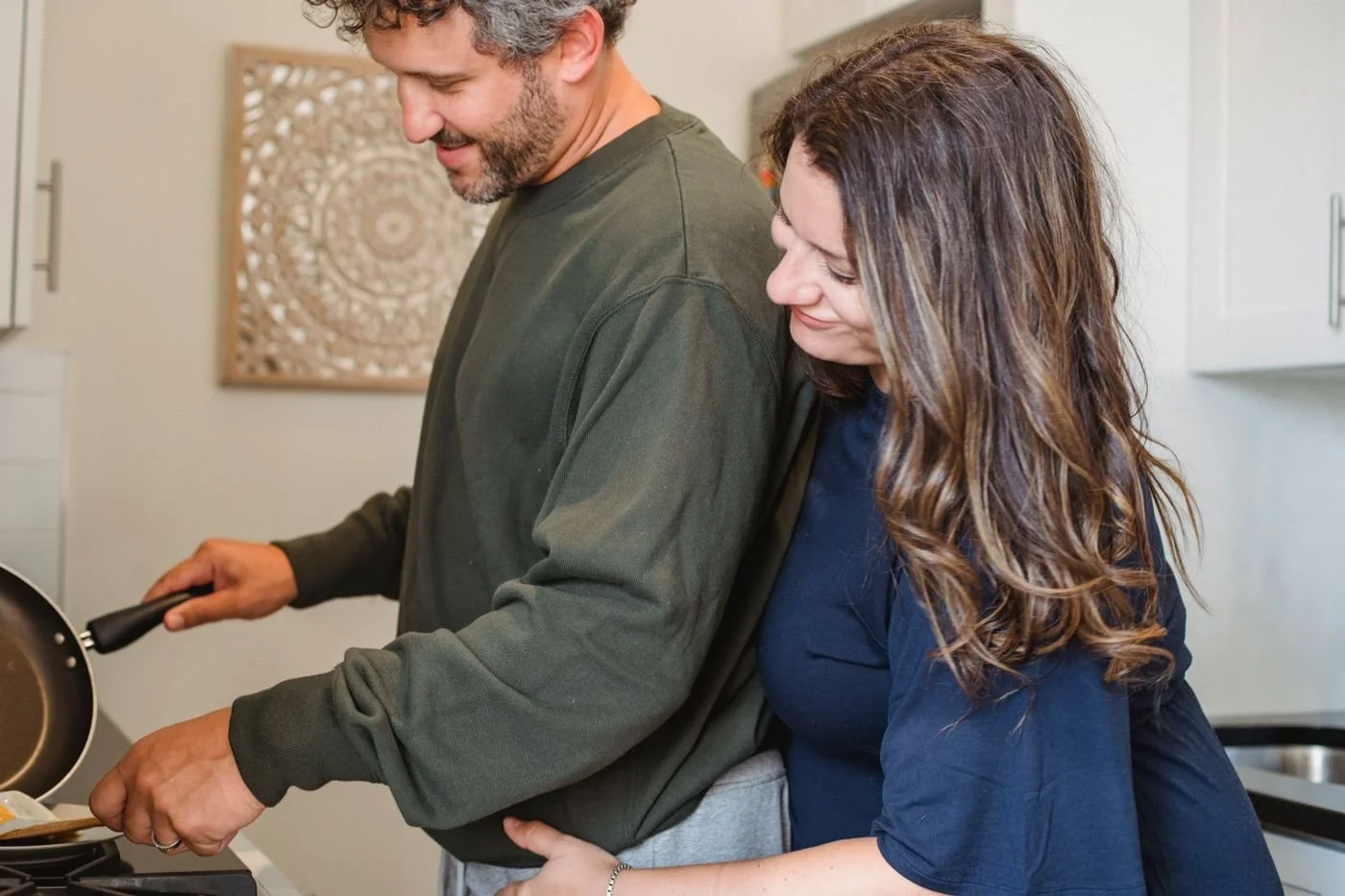
Share an experience, not just a household
Roommates split responsibilities and occupy the same square footage. Partners do things together that neither of them had to do. The difference is the whole ballgame.
Try this: Find one weekly activity with no logistical purpose whatsoever. Cook something ambitious. Walk the same loop. Work on a puzzle. Watch a series you both actually want to watch, not one you settled on.
The requirement is that you're participating in something rather than existing near each other. It gives you material. Couples in roommate mode often find they have nothing to talk about, and the reason is that their entire shared inventory is logistics. Shared experience restocks the shelf.
When it's more than drift
Sometimes distance is just distance and three small shifts close it. Sometimes the distance is doing a job.
If there's an argument you've both silently agreed never to have again, if one of you has been quietly resentful for a couple of years, if reaching toward each other gets rebuffed often enough that you've stopped, that's not busyness. Those situations don't usually resolve through better habits, because the habits keep colliding with whatever's underneath them.
Couples counseling gives you a room where the pattern can happen out loud and get interrupted while it's running. We find what's actually keeping you apart, work on having hard conversations without either person going on the defensive, and rebuild closeness in a way that fits how the two of you specifically operate.
Couples wait, on average, about six years after problems begin before anyone calls a therapist.
That figure comes from Gottman's research, and it's the part I wish more people knew. Waiting rarely improves the odds. Couples who come in while they still like each other tend to move quickly, because there's goodwill to work with. There's nothing weak about making the call early. It's the version of this that works best.
Common questions
Is feeling like roommates normal?
Extremely. Most long-term couples pass through stretches of it, especially in the years with small children or during a demanding period at work. It becomes a concern when it stops being a stretch and starts being the arrangement.
What if I'm the only one who wants to work on it?
That's a common starting point and not a dead end. One person changing how they show up genuinely does shift the dynamic. If it doesn't, that itself is useful information, and worth bringing to a therapist rather than sitting with alone.
How long does it take to feel connected again?
Most couples notice something within a few weeks of consistent effort, which surprises them. Undoing years of drift takes longer, and depends heavily on whether both people are participating.
Do we need couples therapy, or can we do this ourselves?

Plenty of couples handle this on their own. Try the shifts above for a month and pay attention to what happens. If you find yourselves agreeing it's a good idea and then not doing it, or doing it and feeling nothing change, that's the signal to bring in help.
Start with one
Feeling like roommates doesn't mean you've fallen out of love. Usually it means you've fallen out of practice: practice paying attention, practice being a little vulnerable, practice choosing each other when there's something more urgent on the list.
Pick one shift. Not all three. Do it for two weeks and notice what changes, in your partner and in you. The distance built up gradually and without ceremony, which is also how it comes down.
I offer couples therapy in person in West Hempstead and online throughout New York State, including Garden City, Rockville Centre, Hempstead, Franklin Square, and across Nassau County and Long Island.
Schedule a consultation and we can talk about what's been getting in the way.
Eric Taber, Psy.D., is a licensed psychologist in West Hempstead, NY, specializing in couples therapy, premarital counseling, and relationship-focused individual work. He is trained through Level 3 in the Gottman Method and works with couples in person on Long Island and online throughout New York State.
