Premarital Counseling: What It Actually Does, and Why It's Not a Warning Sign

Most couples spend eleven months planning a wedding and about four conversations planning a marriage. That's not a criticism. The wedding has vendors and deadlines and a seating chart that will not build itself. The marriage has no due date, so it waits.
Premarital counseling is a handful of sessions spent on the part that comes after. Not the flowers, not the guest list. What the two of you are actually agreeing to, and whether you're agreeing to the same thing.
The couples I see for this work are, almost without exception, doing well. That's worth saying up front, because it's the single biggest misconception about premarital counseling and it keeps people from doing something that would help them.
What premarital counseling is for
The purpose is not to find out whether you should get married. You've already decided that, and it's your decision to make.
The purpose is to have the conversations that engaged couples tend to skip, on purpose, while things are still calm. Every couple carries a set of assumptions about how married life will run. Where holidays happen. Who handles money. What a fight looks like and when it's over. Whether the plan is two kids or none. Most of these assumptions are invisible until they get contradicted, and the usual place they get contradicted is year three, at eleven at night, when everyone is tired.
Bringing those assumptions into the open before the wedding is easier than repairing the collision afterward. That's the whole idea.
Why couples actually come

The reasons vary more than people expect:
Their officiant asked them to. Many rabbis, priests, and pastors require some form of premarital preparation before they'll perform the ceremony. Couples often arrive treating it as a box to check and leave having gotten more than they planned on.
One or both of them watched a marriage fail up close. Usually their parents'. They want to know what actually goes wrong and whether it's avoidable.
There's one specific unresolved thing. Religion. Whether to have children. A parent who has already made their opinion known. They're not stuck on everything, they're stuck on one thing, and it's not moving.
It's a second marriage, or there are children involved. Blended families come with real structural questions that deserve to be worked out deliberately rather than improvised.
They're doing well and want to keep it that way. This is more common than people assume, and it's a perfectly good reason.
What we actually talk about
Sessions are structured. We're not sitting around waiting to see what comes up. I usually start with an assessment of the relationship so we know where the real friction is rather than guessing, and then we work through the areas that matter for the two of you specifically.
Money
Not budgeting. What money means to each of you. One of you grew up watching your parents fight about it and now cannot look at a credit card statement without your chest tightening. The other thinks of money as something you use. Combining accounts or keeping them separate, debt each of you is bringing in, what counts as a purchase you'd mention first.

Family and in-laws
Whose holidays, how often, and what happens when your mother has an opinion about how you're running your household. Most in-law conflict isn't really about the in-laws. It's about whether each of you will back the other one in the moment.
Children
Whether, when, how many, and what you'd do if it turns out to be difficult. Also how you were each raised and which parts of that you're planning to keep. Two people can both say "I want kids" and mean completely different things by it.
Roles and expectations
Who does what, and, more importantly, what it will mean to each of you if that changes. Careers, relocation, whose job flexes when something has to give.
Conflict
This is often the most useful hour we spend. Every couple has a conflict style, usually inherited. One of you comes from a family that raised its voice and got over it. The other comes from a family where nobody raised their voice and nobody got over anything. Neither is wrong, and they collide badly if nobody's ever named them. A good deal of the Gottman Method is about helping partners recognize these patterns and manage conflict without damage, so I lean on it heavily here.
Intimacy and sex
Expectations, differences in desire, and how you'll talk about it when it changes. Which it will.
Faith, values, and how you'll build the thing
What you want your household to feel like. What rituals you're carrying forward, what you're leaving behind, and what you want to make yours. Couples often find this is the conversation they most wanted to have and had no natural occasion for.
What you actually get out of it
A few things, in rough order of how much they matter.
You find the gaps early. Not deal-breakers, usually. Gaps. The place where you each assumed something and never checked. Finding these before the wedding costs you an awkward afternoon. Finding them in year four costs considerably more.
You get a way to fight. The single most portable thing you'll take out of these sessions is a better process for disagreement, because you're going to disagree regularly for the rest of your lives. Research on premarital education is more modest than the marketing usually suggests, but the piece that consistently shows up is communication and conflict skills.
You practice the hard conversation with a referee. Having a difficult talk once, successfully, with someone in the room keeping it on track, makes the second one on your own much more likely to go well.
You know where the door is. Couples who've been to a therapist together once, before anything was wrong, come back far more readily when something is. That alone is worth the sessions.
Going to counseling doesn't mean something is wrong
I want to be direct about this, because it stops a lot of couples.
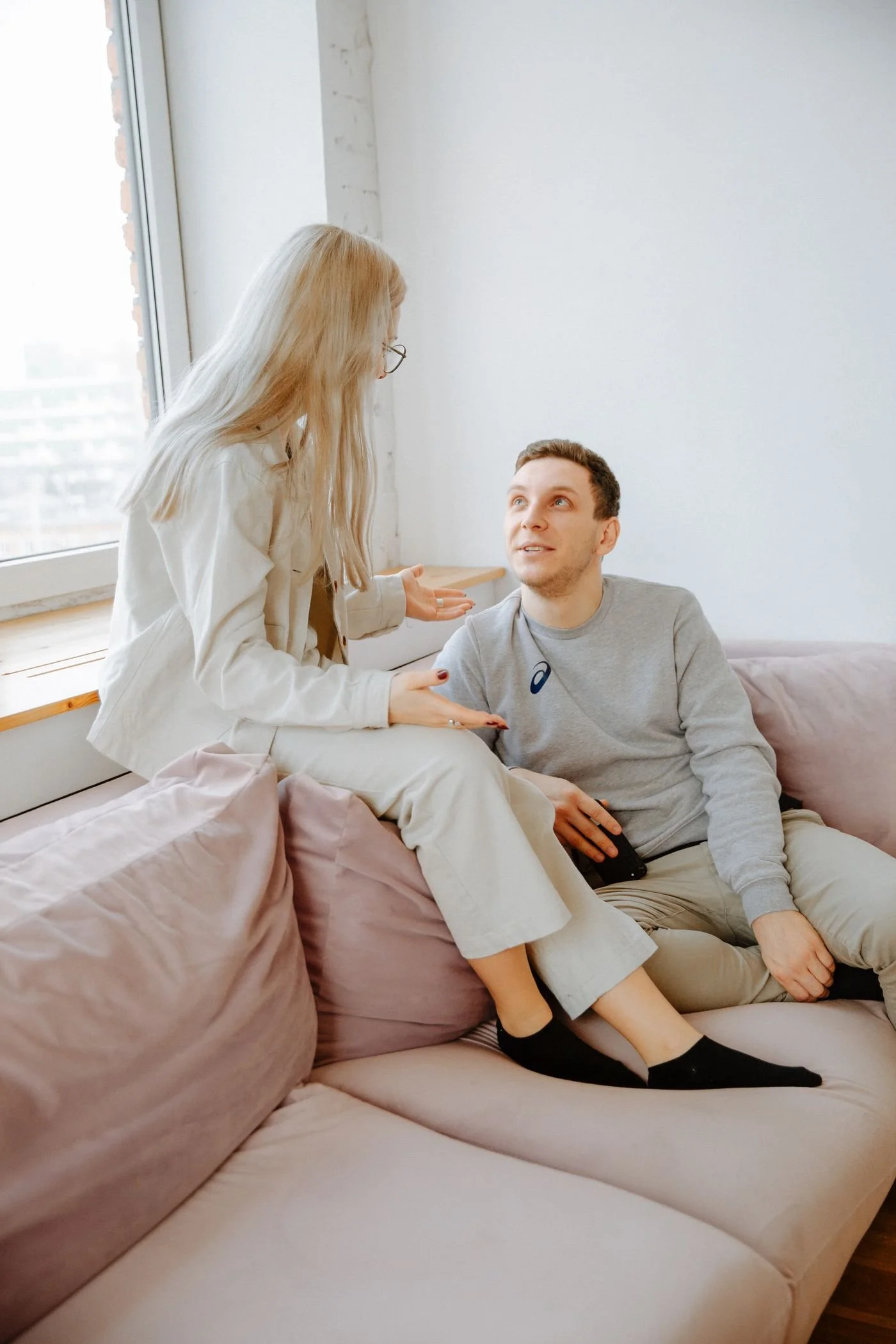
There is an idea that therapy is what you do when the relationship is failing, and therefore that entering a marriage having gone to counseling says something unflattering about it. That framing gets it exactly backward. Nobody thinks a couple has a problem because they met with a financial planner. Nobody assumes the worst because they had a lawyer look at something. Premarital counseling is the same category of act: preparing carefully for something that matters.
The couples who do this are not the ones I worry about.
If you look at it clearly, the willingness to sit down and examine your relationship on purpose, before there's any pressure to, is a strength. It takes some nerve. Couples who can do that at the beginning tend to be the ones who can do it later, when it counts.
Common questions about premarital counseling
How many sessions does it take?
Usually a short, defined stretch rather than open-ended work. We'll set a realistic number after the initial assessment, once I know what's worth spending time on for the two of you.
What if we find out we disagree about something big?
Then you found out now instead of later, which is the point. In my experience these turn out to be workable far more often than couples fear. The ones that don't were going to surface anyway, and it's better to meet them while you still have room to talk.
Does our officiant's requirement count as premarital counseling?
It depends what they're asking for. Some clergy do substantive preparation themselves. Others ask couples to meet with a mental health professional and want documentation. If your officiant has specific requirements, tell me at the outset and we'll make sure the work meets them.
Do we have to be engaged?
No. Couples who are seriously considering marriage or moving in together get the same value out of it. So do couples in a long partnership who never formally did this and want to.
Is this the same as couples therapy?
Related but not identical. Couples therapy usually addresses something that's already causing pain. Premarital counseling is preventive and more structured, working through defined areas rather than following a presenting problem. Some couples do both, at different points.
If you're thinking about it
The best time for this is early enough in the engagement that you're not doing it between the tasting and the final dress fitting. Six months out is comfortable. Three still works. After the invitations go out, everything competes with the wedding.
I offer premarital counseling in person in West Hempstead and online throughout New York State, including Garden City, Rockville Centre, Hempstead, Franklin Square, and across Nassau County and Long Island. I work primarily from the Gottman Method, which gives this kind of preparation a clear structure instead of a series of open-ended conversations.
Schedule a consultation and we can talk about what would be most useful to cover before the wedding.

Eric Taber, Psy.D., is a licensed psychologist in West Hempstead, NY, specializing in couples therapy, premarital counseling, and relationship-focused individual work. He is trained through Level 3 in the Gottman Method and works with couples in person on Long Island and online throughout New York State.
